





How to Stop Slouching: 8 Tips to Fix Your Posture
You're deep into work when you catch your reflection in your laptop screen. Your shoulders are rolled forward, your neck is craning, and your back looks like a question mark. You straighten up immediately, but within minutes you've slumped right back down.
Sound familiar?
Here's what most people get wrong about it. Slouched posture is not a discipline problem. It's a habit your environment trained into you, one hour at a time, and it responds to the same rules every other habit does.
That's the good news. You don't need more willpower. You need a better setup.
How to Stop Slouching: The Short Answer
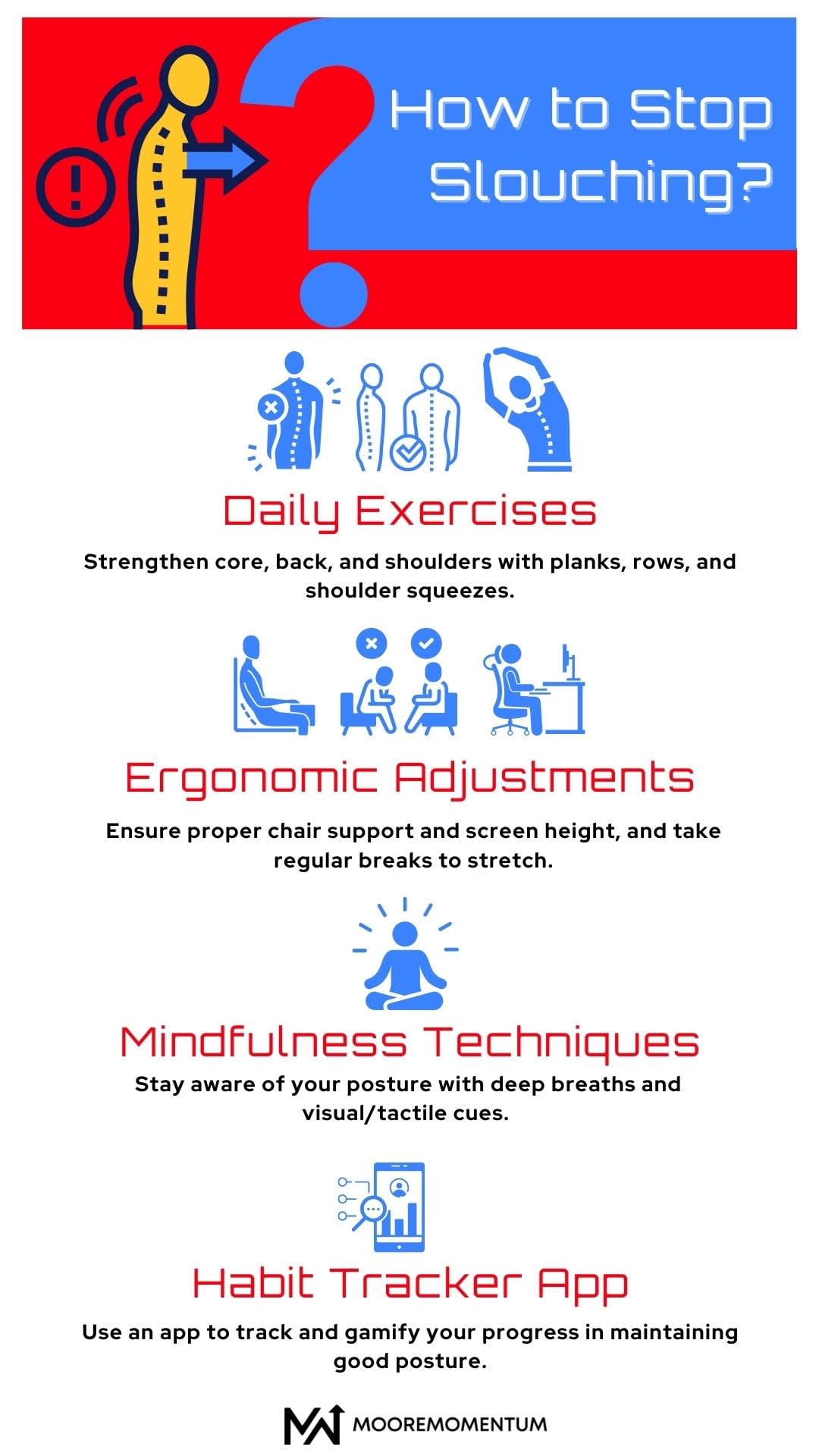
How to stop slouching comes down to three moves working together. Redesign your workspace so upright is the path of least resistance. Strengthen the postural muscles that hold you there. Build automatic awareness triggers so correction happens without conscious effort. Structured programs in this area typically run around eight weeks.
In this guide, you'll discover:
8 practical strategies on how to stop slouching immediately
Science-backed exercises to strengthen your postural muscles
Workspace changes that make good posture the default
Habit design methods that make correction automatic
What Is Slouching? (And Why Your Body Defaults to It)
What is slouching, exactly? It's a postural deviation defined by rounded shoulders, a curved upper spine, and forward head posture, where your head drifts beyond your body's center line.
Understanding what is slouching at a mechanical level matters, because the fix depends on the cause. Several factors drive it.
Prolonged sitting: In a study of 50 office workers wearing accelerometers for a week, Parry and Straker found that sedentary time accounted for 81.8% of work hours, with fewer breaks during work than outside it. Sit that long and hip flexors shorten, glutes weaken, and your body settles into whatever position costs the least energy.
Excessive screen time: Working on computers or scrolling phones pulls your head forward, loading the cervical spine. Building healthy digital habits attacks the cause rather than the symptom, because stretching won't offset nine hours of craning.
Poor ergonomics: Monitors set too low, chairs without lumbar support, and awkward keyboard heights all pull you into a slouch posture by default.
Muscle imbalances: Years of slouching create a predictable pattern. Tight chest muscles pull the shoulders forward, weak upper back muscles can't counteract that pull, and a weak core can't stabilize the trunk.
Lack of body awareness: Most people don't notice they're slouching until something hurts. Without conscious intervention, poor posture becomes the default setting.
Here's why a slouch posture feels comfortable. Gravity pulls you down constantly, and holding upright requires continuous muscle activation. When those postural muscles fatigue, your body takes the path of least resistance and collapses.

Why Slouched Posture Is Sabotaging Your Health and Confidence
The costs of chronic slouched posture run well past appearance.
Physical Impacts
Musculoskeletal stress: Hansraj's biomechanical model in Surgical Technology International estimated the load on the cervical spine at increasing head tilt, starting at roughly 10 to 12 pounds in neutral and rising as the head tilts forward. This is a calculated model rather than a direct measurement, but the direction is clear: the further forward your head sits, the harder your neck works to hold it.
Reduced respiratory function: Forward head posture affects breathing mechanics. A cross-sectional study of 99 chronic neck pain patients found negative correlations between forward head posture and expiratory muscle strength. The correlations were weak to moderate, so this is a real but modest effect that compounds over years rather than appearing overnight.
Muscle imbalances: Slouching creates tight chest muscles and overstretched, weak upper back muscles. Each reinforces the other in a loop that gets harder to break the longer it runs.
Spinal misalignment: Chronic slouching can reduce the natural neck curve and exaggerate the upper back curve. These changes restrict movement and get progressively harder to correct, which is why preventative habits matter more here than corrective ones.
For scale on how common spinal pain is, the Lancet Low Back Pain Series reports that low back pain is now the leading cause of disability worldwide, across high, middle, and low income countries and every age group.
Mental and Emotional Impacts
Confidence: A randomized trial published in Health Psychology placed 74 participants in either an upright or slumped seated posture and put them through a social stress task. Upright participants reported higher self-esteem, better mood, and lower fear than slumped participants. Linguistic analysis showed slumped participants used more negative emotion words during their speeches.
Energy and mood: A follow-up randomized study of 61 people screening positive for mild to moderate depression found that upright posture improved affect and reduced fatigue during a stressful task. Posture is not a treatment for depression, but the link between how you hold yourself and how you feel is measurable.
Stress: In the same Health Psychology trial, upright participants held onto their self-esteem under pressure in a way slumped participants did not. That suggests posture influences how you handle stress, not just how you look while handling it.
The encouraging part is that all of this responds to work. Learning how to get rid of poor posture is less about anatomy than about habit architecture.
How to Fix Slouching: 8 Strategies That Actually Work
Tip #1: Transform Your Workspace Environment
Optimize setup and movement patterns. Your workspace configuration determines whether upright is easy or exhausting. Position your monitor so the top third sits at or slightly below natural eye height, which prevents forward head drift. Use a laptop stand with an external keyboard if needed. Adjust your chair so your feet rest flat with thighs parallel to the ground, and add lumbar support. Position keyboard and mouse so your elbows form ninety-degree angles.
This single change does more for how to stop slouching when sitting than any exercise on this list, because it removes the reason you slouch in the first place.
Then add movement. Set a reminder to stand or shift position every thirty to sixty minutes, and use those breaks for arm circles, overhead reaches, and hip flexor stretches. These short bursts work the same way two-minute exercise snacks do, breaking up static loading without needing a gym or a change of clothes.
While you're at it, the 20-20-20 rule is worth adopting for your eyes: every twenty minutes, look at something twenty feet away for twenty seconds. It won't fix your spine, but it pairs naturally with a posture check.
Tip #2: Build Comprehensive Core Strength
Strengthen your body's natural support system. Your core stabilizes the spine and pelvis, which is what makes how to stop slouching when sitting through a long session physically possible. Without adequate strength there, your spine has no platform to hold alignment against gravity.
Start with planks. Forearms on the ground, body in a straight line from head to heels, holding ten to thirty seconds and building from there. Add side planks for the obliques. Practice dead bugs, extending opposite arm and leg while keeping your lower back pressed to the floor.
Include bridges for glutes and hamstrings, and supermans that lift arms, chest, and legs together. Aim for a short session a few times a week rather than long occasional ones. Treat this like any other long-term health goal, because postural endurance is built on repetition, not intensity.
Tip #3: Master Corrective Exercises and Stretches
Target specific muscle imbalances. Specific exercises address the specific imbalances chronic slouching creates.
Practice chin tucks by gently drawing your chin straight back, feeling the stretch at the base of your skull, and holding briefly. This targets the deep neck flexors responsible for head position.
Perform shoulder blade squeezes by drawing the blades together without shrugging. Try wall angels by standing against a wall and sliding your arms up in a goal-post position while maintaining contact.
Add the cat-cow stretch on hands and knees, flowing between arching and rounding with your breath.
Each of these takes under a minute, which is what makes them stick. They're micro habits small enough that skipping them takes more effort than doing them.
Tip #4: Implement Automated Awareness Systems
Create triggers for constant posture monitoring. Automated triggers build awareness without draining willpower. The most reliable habit triggers are the ones already built into your day, so anchor posture checks to cues you can't miss.
Set recurring phone alerts with a simple "posture check" message. Take a few seconds to assess and adjust when they sound.
Place visual cues where your eyes already go: a note on the monitor edge, one on the bathroom mirror. Rotate them so your brain doesn't filter them out. Stack posture checks onto existing behavior using the habit stacking pattern: "After I take a sip of water, I check my posture."
Tip #5: Develop Daily Postural Mindfulness
Build body awareness through systematic scanning. Regular check-ins catch problems before they compound. Set three anchor times daily, morning, midday, and evening, for a two-minute body scan.
Run a head-to-toe check. Is your head forward of your shoulders or stacked above them? Any neck tension? Are your shoulders rolled forward or relaxed back? Does your lower back have an appropriate curve?
Notice without judgment. Observe "I'm currently slouching" rather than criticizing yourself. It's the same skill being present asks for anywhere else, and posture is an easy place to practice it.
Close your eyes periodically and sense your position without looking, then check in a mirror. Chronic slouching dulls your sense of where your body actually is, and this retrains it.
Tip #6: Establish Your Standing Posture Baseline
Recalibrate what proper alignment feels like. The wall test gives you an objective reference. Stand with heels six inches from a wall, put your buttocks against it, press your shoulder blades back to make contact, and bring the back of your head to touch. Check that a small gap exists at the lower back. That's your neutral.
Perform it daily for a minute or two, then step away and walk while holding the alignment.
If your head won't reach the wall, you have significant forward head posture and need dedicated chin tucks. If you lean forward when standing, that points to weak glutes and core paired with tight hip flexors. Stretch the hip flexors in a lunge and strengthen glutes with bridges.
Tip #7: Optimize Sleep Posture for Round-the-Clock Support
Align your spine during recovery hours. You spend a third of your life asleep, and that third either supports your daytime work or undoes it.
Back sleeping and side sleeping both work well when set up properly. On your back, place a pillow under your knees to preserve the lumbar curve and use a pillow that supports your neck without pushing your head forward. On your side, place a pillow between your knees to keep hips, pelvis, and spine aligned.
Stomach sleeping is the one to avoid, since it forces extreme neck rotation and flattens the lumbar curve.
Do gentle cat-cow and hip flexor stretches before bed to release accumulated tension. Notice how you feel on waking. Stiffness or pain is a signal your sleep setup needs adjusting.
Tip #8: Create a Comprehensive Habit System
Make good posture automatic through strategic design. Posture isn't a routine habit you perform once at a set time. It's an all-the-time habit that has to hold across every hour of your day, which is why environment design beats motivation here.
Build implementation intentions with specific if-then plans: "If I notice neck tension, then I perform five chin tucks." Design your space so correct ergonomics are the default and your exercise equipment stays visible.
Track it. A weekly habit tracker marking completed exercises, plus check-ins on pain and energy and monthly progress photos, turns invisible progress into visible evidence.
Celebrate milestones at seven and thirty days. Each one is proof of an identity-based habit shift, moving you from "I'm trying to sit up straight" to "I'm someone who sits tall." That shift is what makes the change permanent, and it runs on the same cue, craving, response, reward loop underneath every habit you already have.
How to Get Rid of Slouch Lines
Slouch lines, the horizontal creases across the neck and vertical lines on the chest, are visible evidence of chronic forward head posture folding the same skin over and over.
How to get rid of slouch lines means working on two fronts at once, because treating the skin without fixing the posture just resets the clock.
Posture improvement: Address the root cause first. This is why how to get rid of slouch lines always starts with alignment rather than skincare.
Targeted exercises: Chin tucks and neck stretches strengthen the muscles holding your head in position.
Skin care: Retinoid serums, daily moisturizing, and SPF protection support the skin where the creasing occurs.
Professional treatments: Options including micro-needling and laser treatment exist, though a qualified provider should assess whether they're appropriate for you.
Skin changes are gradual, so give consistent posture correction several months before judging results. Prevention is considerably easier than reversal.
How to Prevent Slouching After You've Fixed It
Knowing how to prevent slouching long term is a different problem from fixing it, and most people skip this part.
Once alignment improves, the environment that created the original slouch posture is usually still sitting there. The monitor is still low. The chair still has no lumbar support. The workday hasn't changed.
How to prevent slouching permanently means auditing your setup regularly rather than once. Check monitor height after any desk change, hotel stay, or new laptop. Keep two or three of the corrective exercises in permanent rotation rather than retiring them once the pain stops.
Most importantly, keep the awareness triggers running at reduced frequency. Twice daily instead of hourly is enough maintenance to catch drift before it becomes a pattern again.
Conclusion: How to Fix Slouching
You now understand what slouching is, recognize what slouched posture costs you, and have 8 practical strategies for correction. A slouch posture isn't permanent. It's a habit you can change through consistent action.
You don't need perfection. You need small, consistent actions that compound over time, which is what separates habit streaks that actually hold from the ones that collapse after a missed day. Start with your workspace today. Add one exercise tomorrow. Build awareness the day after.
Give it a couple of months of steady work and you should notice less tension, more energy, and a real difference in how you carry yourself. Those changes ripple outward, into mental clarity, emotional steadiness, and how you show up with other people.
You have the roadmap for how to fix slouching. But posture is one piece of the Physical Health puzzle, and physical health is one of the five core areas of life that determine your overall vitality.
🚀 READY TO LEVEL UP YOUR PHYSICAL HEALTH (AND THE REST OF YOUR LIFE)?
You just learned how to fix your posture, but that's one aspect of a single Core Area. Physical Health is one of five interconnected cores that fuel your momentum in life.
The strategies in this guide come from the Moore Momentum System, a science-backed, AI-personalized platform that makes building healthy habits simple, fun, and rewarding across all 5 Core Areas: Mindset, Career & Finances, Relationships, Physical Health, and Emotional & Mental Health.
Your posture improvements create a ripple effect. Better energy fuels clearer thinking, which lifts work performance, which builds confidence in relationships, which steadies your emotional balance.
👉 Take the Core Values Quiz to discover your current Momentum Score and see which Core Areas are silently draining your energy. It takes 60 seconds and gives you a personalized roadmap for your next Golden Habit.
GET YOUR PERSONALIZED MOMENTUM SCORE NOW!
🚀🚀🚀 Don't forget to check out our RESOURCE ARCADE 👾🎮 for FREE templates and tools to gamify your habits.

FAQs: How to Stop Slouching
How to stop slouching when sitting at a desk?
Start with the three-point contact rule: feet flat, buttocks fully back in the seat, lower back supported. Then raise your monitor so the top third sits at eye level, since a low screen is the most common reason people collapse forward without noticing. Add reminders to shift position through the day. The piece most people skip is strength, because reminders only work if your core can hold the position once you correct it.
How to fix bad posture without a gym or equipment?
How to fix bad posture at home works fine with bodyweight movement and a few environment tweaks. Planks, bridges, wall angels, and chin tucks need no equipment. A stack of books raises a laptop to eye level, and a rolled towel becomes lumbar support. Most people who fail at this fail on consistency, not equipment.
How to improve posture if you work from home?
Offices build in movement you don't get at home: walks to meeting rooms, trips to a colleague's desk, a commute. How to improve posture from home means adding that movement back deliberately. Set timers, stand for calls that don't need your screen, and take a short walk at the times you would have commuted. Then fix the setup, because working from a couch guarantees a slouch posture no matter what you do afterward.
How to get rid of poor posture that's been there for years?
How to get rid of poor posture built over decades is slower, but the process is the same. The imbalances are more entrenched, so prioritize mobility work early. Stretching tight hip flexors and chest muscles has to come before strengthening will hold. Correct alignment often feels wrong at first, simply because your body has adapted to the old position.
How do I know if my posture is bad?
Use the wall test. Stand with your heels about six inches from a wall and check whether your buttocks, shoulder blades, and the back of your head all make contact comfortably. Slide a hand behind your lower back. A small gap is normal, a large one isn't. If holding the position feels like effort rather than rest, your postural muscles have deconditioned. A side-profile photo taken by someone else is often more revealing than a mirror.
Why do I lean forward when I stand?
Forward leaning is usually a muscle imbalance rather than a spinal problem. Prolonged sitting shortens the hip flexors while the glutes weaken from disuse, which tilts the pelvis forward and makes your upper body compensate. Stretch the hip flexors in a lunge, strengthen glutes with bridges, and add planks for core stability.
How to get rid of slouch lines on my neck?
Slouch lines form when forward head posture folds the same section of skin repeatedly. Fix the posture first, since no topical treatment outpaces continued compression. Then support the skin with retinoid serums, daily moisturizer, and SPF. Micro-needling and laser treatment are options worth discussing with a qualified provider. Expect gradual change over several months.
How to prevent slouching from coming back?
How to prevent slouching long term means maintaining the environment, not just the exercises. Audit your workspace regularly, since monitor height drifts after any desk change or new laptop. Keep two or three corrective exercises in permanent rotation, and run posture checks twice daily as maintenance.
How long does it take to correct posture?
Structured programs in this area typically run about eight weeks. In one randomized trial of 74 people with forward head and rounded shoulder posture, eight weeks of guided cervical and thoracic training produced significant improvements in head and shoulder angles, neck pain, and neck function compared to a control group. Your own timeline depends on consistency, how entrenched the imbalances are, and whether you actually fixed your workspace. This tracks with the broader science on how long it takes to change a habit, since posture correction is largely a habit problem.
How does screen time contribute to slouching?
Screens pull your head forward as you lean toward them, and the problem is duration rather than any single moment. Holding that position for most of the day trains your muscles and connective tissue to accept it as normal. Raise devices toward eye level where you can, and run posture checks during use rather than after.
Can poor posture affect your mental health?
Randomized research suggests posture and mood interact, though the effect is more modest than popular claims imply. Participants held upright during a social stress task maintained higher self-esteem and better mood than those held slumped, and a separate trial found upright posture reduced fatigue in people with mild to moderate depressive symptoms. Posture is not a substitute for professional care, but the relationship is measurable.
Can I reverse long-term slouching, or is the damage permanent?
Most cases improve, even after decades. Muscle imbalances, shortened hip flexors, and weak postural chains are adaptations, and adaptations respond to new input. The exceptions involve genuine structural change such as pronounced kyphosis, vertebral fractures, or scoliosis, which are medical conditions requiring professional assessment rather than habit problems.
This article is for informational purposes and is not a substitute for medical advice. If you have persistent pain, numbness, tingling, or a diagnosed spinal condition, consult a physician or licensed physical therapist before starting any exercise program.


Founder & CEO of Moore Momentum
Will Moore is a serial entrepreneur, life coach, and habit science expert with a $300M+ exit under his belt. After hitting suicidal rock-bottom as a teen, he dedicated his life to cracking the code on lasting happiness and success — and built Moore Momentum to share what he found.
He helps people discover WHO they are, WHAT they really want, and HOW to get there by combining proven principles, science, AI, and gamification.
His mission: make growth ethically addictive and inevitable.