





How to Believe in Yourself When Nobody Else Does
At 18, I was suicidal. Not in a dramatic or metaphorical way. I truly did not want to live anymore.
I had just been rejected by every fraternity in my freshman dorm. While the other guys celebrated in the hallway; laughing, shouting, feeling like they belonged. I sat alone in my dark college room, convinced of one thing: I will never be good enough for this world.
That night, I locked my door, turned off the lights, and seriously questioned whether I wanted to keep going. The version of me sitting there — ashamed, isolated, and completely broken — could never have imagined what would happen next.
Today, I’m the founder of a company that sold for more than $321 million. I built a gamified habit-change system that helps thousands of people break out of the same failure loops I once felt trapped in. I’m married to the love of my life. I’m a dad. And more than anything, I believe in myself fiercely and without apology.
But I didn’t get here by accident. And I definitely didn’t get here by reading a few motivational quotes online.
If you’re here because you’re trying to figure out how to believe in yourself especially when it feels like no one else does. I want you to know this: belief is not something you’re simply born with. It is something you build. Brick by brick. Habit by habit. Day by day.
Before we go further, let’s be clear about what it actually means to believe in yourself. It does not mean being arrogant. It does not mean pretending to be happy and thinking life is perfect. It means trusting that, no matter what happens, you can find a way forward.
And if you don’t believe in yourself, who will? No one else can do that work for you. But this guide will show you how to start.
Whether you're starting from scratch or figuring out how to believe in yourself again after a rough patch, this guide meets you where you are.
By the end of this article, you'll know:
What self-belief actually means and why it's the foundation of everything
Why you stopped believing in yourself, and what's really driving it
10 specific, science-backed strategies to rebuild your belief from the ground up
How to turn setbacks into fuel instead of proof you're not enough
Let's begin.
What Does It Mean to Believe in Yourself? (And Why It Matters)
Believing in yourself means trusting that you have the ability to learn, adapt, and handle whatever life throws at you. It's not about being perfect or having all the answers. It's about choosing to move forward anyway. In short: self-belief is the decision to back yourself before the results show up.
So what does it mean to believe in yourself at a deeper, scientific level? Psychologists call it "self-efficacy". A concept developed by Stanford psychologist Albert Bandura to describe your belief that your actions can make a real difference. Bandura’s decades of research made one thing clear: people with strong self-efficacy are more willing to take on difficult challenges, more likely to keep going when things get hard, and better able to bounce back after failure.
In other words, what you believe about yourself shapes what you do. And over time, what you do shapes who you become.
Why does this matter? Because self-belief is the foundation for growth in every area of life. When you believe in yourself:
You're more likely to take on new challenges and pursue your goals
You bounce back faster from setbacks and failures
You experience less anxiety and more motivation
You build stronger relationships because you're not constantly seeking approval
Before you can change your habits or your results, it starts with changing the story you tell yourself about what's possible.
Read More: How to Win at Life

Why We Stop Believing in Ourselves
For years, I carried this heavy, sinking belief: I can't believe this is my life. I found myself constantly asking, "Why don't I believe in myself? Why does everything feel harder for me than it does for everyone else?"
I wasn't alone in that. Research often suggests that the average person has tens of thousands of thoughts each day. And for people caught in self-doubt, many of those thoughts tend to lean negative. That inner critic does not just whisper in the background. For a lot of people, it takes over the entire conversation.
We stop believing in ourselves because:
We compare our behind-the-scenes to someone else’s highlight reel
We fail once (or ten times) and assume it means we’re doomed
We grew up absorbing limiting beliefs — from parents, teachers, peers — about what we could or couldn’t be
We repeat bad habits that quietly reinforce the identity of someone who “just doesn’t have it"
Those habits might seem small — sleeping in, avoiding discomfort, doom scrolling instead of doing the thing but over time, they compound. What starts as procrastination becomes a personality. What begins as hesitation becomes your whole story.
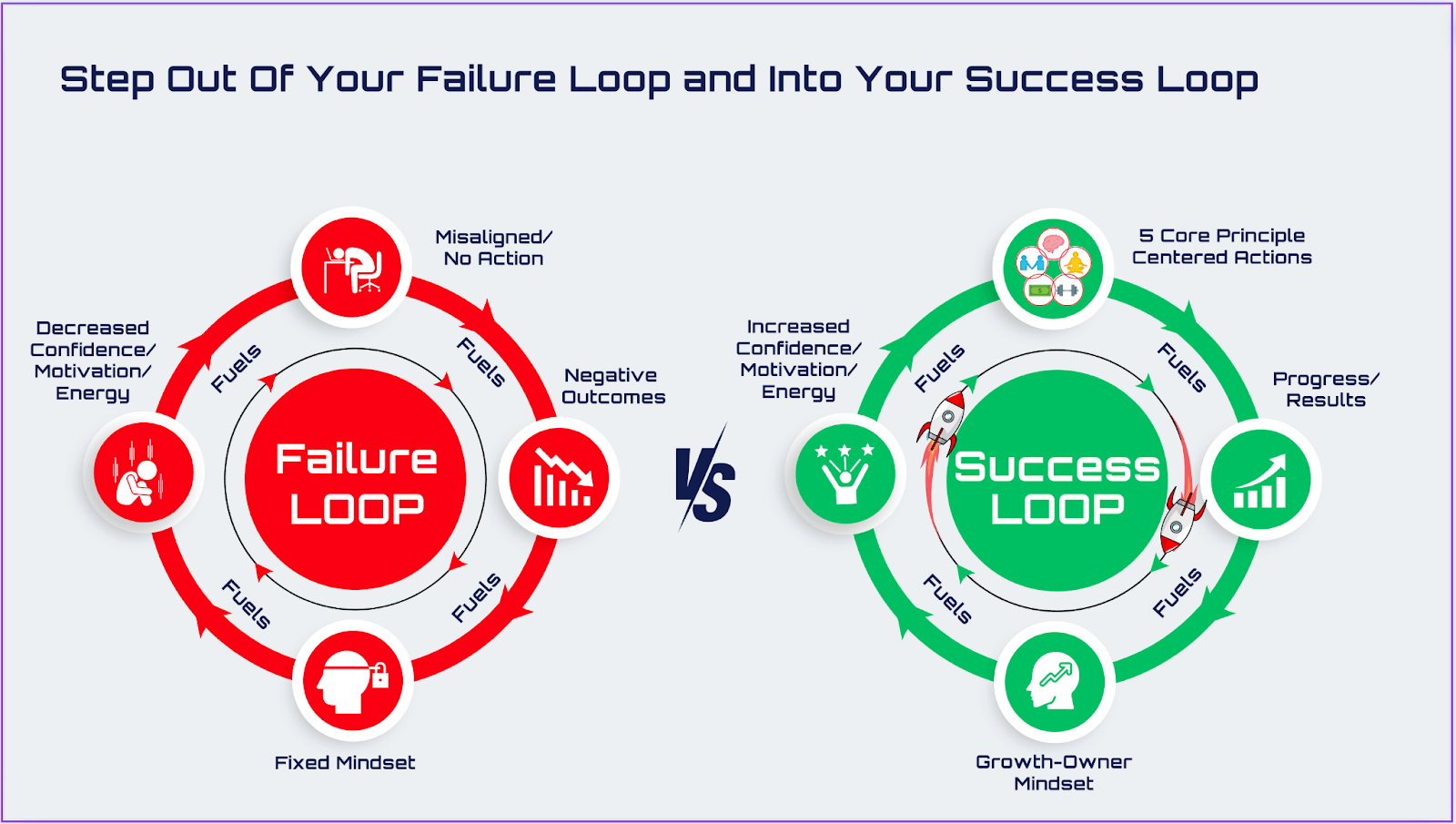
The good news? Figuring out how to believe in yourself again after hitting that wall isn't a mystery — it's a process. Those same neural pathways that trapped you in a Failure Loop can carry you into a Success Loop. That happens with tiny wins, tracked progress, and consistent identity upgrades. That's how I did it, and it's how you can too.
Believing in yourself is the first step to success but it's not about blind optimism. It's about building the habits that turn belief into behavior.

10 Ways to Believe in Yourself (That Actually Work)
If you're wondering how to believe in yourself when nobody else does, this is where you start.
1. Start With One Small Win
When you're buried in self-doubt, everything feels overwhelming. Dreams shrink. Goals that once inspired you now feel like a cruel joke. But the truth is, confidence doesn't come from massive leaps. It comes from stacking small, winnable moments that remind you what you’re capable of.
After that lowest night in college — locked in my dorm room, hiding from the celebration outside — I didn’t suddenly transform. Weeks later, in a Religions of the World class, my professor casually mentioned a book that had changed his life. I don’t know why, but something in his voice made me pay attention. I walked into the campus library after class and asked for How to Win Friends and Influence People.
That book became a gateway. One chapter led to another, one book led to a dozen more. That one action, seemingly irrelevant at the time, became the catalyst for everything that came after.
Small actions, repeated consistently, rewire your identity.
Try this:
Pick one small win today from one of the 5 Core Areas of your life:
Mindset: Read 10 pages of a book that challenges your thinking
Career & Finances: Declutter your inbox or plan tomorrow’s top task
Relationships: Text someone a genuine compliment
Physical Health: Do 3 pushups or go for a 10-minute walk
Emotional Health / Giving Back: Write down one thing you're grateful for
Small changes lead to big results. Momentum doesn't start with a miracle. It begins with movement.
Related: Keystone Habits: Improve Your Life with Simple Changes
2. Reframe the Inner Critic
There's a moment I'll never forget. We were in the early days of building our food delivery startup. We'd blown through way more cash than planned, the operations were barely holding together, and then I got the call: our GM had stolen from us and lied about being with her dying grandmother to cover it up.
I remember sitting at my desk, completely stunned. That familiar voice started creeping in: This is why you'll never succeed. You're too trusting. You're not cut out for this.
In the past, that voice would've taken over. But something had changed.
Years earlier, when I was at rock bottom, I started doing the work, learning how to spot that inner critic, challenge it, and replace it. Every time I found myself asking "why don't I believe in myself?" I treated it not as a verdict, but as a habit to interrupt. I realized the story I kept telling myself — you're not good enough — wasn't a fact. It was a loop. And loops can change.
One of the most powerful reframes for anyone wondering how to believe in yourself again after a series of setbacks is this: the inner critic isn't the truth. It's a pattern. Patterns can be broken.
So that day, I rewrote the message: You're learning. You're not perfect. But you're still here, and you're still moving.
Try this:
Start a "Thought Reframe Log" — every time your inner critic pipes up, write down:
The thought ( I am never going to get it right.)
The trigger (Messed up a meeting or task)
A reframed version that’s grounded but empowering (I’m still learning. Every mistake is training)
Review it weekly. This simple habit rewires your self-belief and trains you to become your own biggest ally, not your worst enemy.
For a deeper dive into this mindset shift and a powerful mental model that supports it, check out the CBRP Mental Framework.
3. Anchor Confidence in Effort, Not End Results
In the early days of our startup, everything was going sideways — we were bleeding cash, our GM stole from us, and competitors were catching up fast. I used to tie my confidence to outcomes, so when things failed, I felt like a failure.
But during that chaos, I started shifting my focus. Instead of obsessing over what went wrong, I asked: Did I show up today? Did I take a step forward?
That simple shift helped me build a different kind of self-belief — one rooted in action, not achievement. This gets to the heart of what does it mean to believe in yourself in a sustainable, lasting way: it means trusting your effort, not guaranteeing your outcome. Albert Bandura called these "mastery experiences" — the repeated, effort-based wins that build self-efficacy from the inside out. When I finally said I believe in myself, it wasn't because everything had gone right. It was because I had showed up enough times to trust that I would keep showing up.
If you're constantly wondering how to believe in yourself and be confident, maybe you're measuring the wrong thing.
Try this:
Every day, track one action in a Core Area you want to grow:
• Mindset – Journal for 5 minutes • Career – Reach out to one lead • Health – Move your body for 10 minutes
Confidence isn’t something you wait for. It’s something you build — one action at a time.
Read More: How to Work on Yourself
4. Make Self-Care a Non-Negotiable
One of the hardest lessons I had to learn was that beating yourself up isn't a path to growth — it's a guarantee you'll stay stuck.
A lot of people who ask "why don't I believe in myself?" are quietly neglecting the basics. Sleep. Movement. Food. Boundaries. When your body is running on empty, your mind follows. Self-doubt doesn't just live in your thoughts, it lives in your nervous system, and it gets louder when you're depleted.
For a long time, I thought self-care was soft — a luxury for people who already had their lives together. But the truth is, practicing self-love is foundational to self-belief. It's not about bubble baths and spa days. It's about honoring your body, mind, and boundaries like someone who matters. Because you do. Learning to have faith in yourself starts with treating yourself like someone worth investing in.
For me, it started with daily walks, balanced meals, journaling, and sticking to a routine that made me feel stable. Small acts of self-respect, repeated consistently, helped me rebuild the identity of someone worth taking care of.
Try this: Choose one healthy daily routine that supports your energy and mindset:
Prepping one nourishing meal
Doing 15 minutes of movement
Practicing mindfulness
Blocking time to rest without guilt
You don’t earn self-care — you build from it.
Learn More: How to Change Your Life in 30 Days
5. Surround Yourself With Believers
When you're trying to rebuild your life, the last thing you need is people feeding your doubt. But that’s exactly what many of us deal with — passive-aggressive friends, skeptical family, colleagues who subtly dismiss our ideas.
And here's the uncomfortable truth: if you don't believe in yourself, who will. If the people closest to you are actively reinforcing the wrong story? Your environment shapes your belief system more than most people realize. If you always believe in yourself in isolation but spend every day surrounded by people who don't see your potential, the math eventually stops working in your favor.
Early on, I didn't have a support system cheering me on. When I left my real estate job to build what would become Doorstep Delivery, most people thought I was out of my mind. But there was one person I did believe in: my best friend.
I pitched him the idea. He hesitated. But eventually, he said yes. That decision changed both our lives. We weren't experts. We weren't confident all the time. But we believed in each other enough to start. And that shared belief carried us through moments when everything else seemed to be falling apart.
Confidence is contagious. Just one voice — someone who sees your potential and says "Let's go" — can make all the difference.
Try this:
Take five minutes today and audit your inner circle. Who energizes you? Who drains you? Then take one action: reach out to a growth-minded friend, a life coach or career coach, or someone whose belief could help steady your own.
But what if you don’t have a supportive network yet?
If you don't have that network yet, start building it — join communities focused on growth, attend a workshop, or form a small accountability group with weekly check-ins. Mutual belief compounds.
Read More: How to Be a Better Listener
6. Learn a New Skill and Track It
One of the quickest ways to break the belief that “I’m not good enough” is to prove, through action, that you’re capable of changing yourself.
Learning a new skill creates that evidence. If you're figuring out how to believe in yourself again, this is one of the fastest paths there. Every time you commit to learning something outside your comfort zone and follow through, you prove to yourself — in concrete, undeniable terms that you are capable of growth.
When I started building my company, I wasn't a tech guy. I didn't know how to write code or design an app. But I was learning. I leaned into my strengths, strategy, design thinking, leadership and taught myself everything else along the way. Learning to have faith in yourself isn't about waiting until you feel ready. It's about doing the thing and watching the readiness show up.
Try this: Pick one skill in a Core Area where you currently feel stuck.
Mindset: Learn a journaling or mindfulness technique
Career/Finances: Take a short online class or read a business book
Relationships: Practice active listening in your next conversation
Physical Health: Learn one proper movement pattern or recipe
Emotional Health: Try a new way to reset your nervous system (like breathwork)
Track your progress daily in a habit tracker app. Small effort, logged consistently, will build your evidence file. And that file? That’s where self-belief starts to rewrite itself.
Read more about: How to track habits
7. Celebrate Micro-Wins (Even If They Feel Silly)
One of the biggest reasons we stop believing in ourselves is because we don't give ourselves credit when we actually do something right.
We're great at noticing failures. But when we do something good? We barely blink. The brain shrugs and moves on, still scanning for what's wrong.
Here's the thing: your self-belief is shaped by the evidence you pay attention to. If you only focus on where you fell short, your confidence shrinks. But if you learn to celebrate progress — no matter how small — that belief starts to build. This is precisely how to believe in yourself when the big wins feel far away: you manufacture evidence, one small victory at a time. When I finally reached the point where I could say I believe in myself without hesitation, it wasn't one big moment that got me there — it was ten thousand small ones I'd bothered to notice and acknowledge.
The goal isn't to always believe in yourself perfectly from day one. The goal is to always believe in yourself enough to take the next step — and then celebrate that you did.
When I was rebuilding my life, I made this a personal rule: wins count, even if no one sees them. Whether it was finishing a book, making it to the gym, or having a difficult conversation I'd been putting off — I tracked it. And I acknowledged it. Because those little wins were proof that the tide was turning. That I wasn't stuck. That I was becoming someone new.
Try this:
At the end of each day, write down one win - big or small - that made you proud.
Did you follow through on something?
Make a better choice than usual?
Get through a hard conversation?
Say it out loud if you want to make it stick. Even better? Share it with a friend. You can’t build confidence if you never stop to see what you’ve built.
Related: How to Use The Compound Effect to Create Unstoppable Momentum
8. Visualize Who You’re Becoming
If you've ever asked what does it mean to believe in yourself in a practical, day-to-day sense, here's one answer: it means you can picture clearly and consistently — the person you're becoming, and you choose to act like that person before they've fully arrived.
There's a version of you that already exists — not in some fantasy, but as a trajectory. It's the version that emerges when your habits line up with your personal values. The problem is, most people never take time to actually picture who that person is.
One powerful way to anchor this is with a personal mantra. Here's what I say during my morning stretch: "I am strong, focused, and building momentum every day. I've already overcome so much. I believe in myself, and I am becoming the person I'm meant to be."
To always believe in yourself through the difficult seasons, you have to have faith in yourself enough to act from that future identity before the results confirm it. That's the practice. Not the feeling — the action.
Try this:
Each morning this week, close your eyes and visualize the future version of you, not just what they have, but how they show up.
How do they carry themselves when they walk into a room?
How do they handle pressure, speak to others, care for their body?
What are 3 habits they follow that you’re not following yet?
Then choose one of those habits and take a single step toward it.
Need help getting clear on that future version of yourself? Download the Back to the Future Planning Guide — it’s a practical tool to help you align today’s actions with tomorrow’s vision.
Read More: What Are the Top Five Things That Make You Happy in Life?
9: Overcome Setbacks by Turning Failure Into a Blueprint
Failure used to feel like proof that I was falling behind — or worse, that I didn’t belong in the game at all. Every mistake triggered that critical inner voice: You always mess things up. You’re not built for this.
But over time, I learned how to turn failure into my greatest teacher. The shift came when I stopped seeing it as a verdict and started seeing it as feedback.
This is how you build resilience: not by avoiding failure, but by facing it, reflecting on it, and using it to grow. It starts with radical acceptance — naming the setback, owning your part, and choosing to move forward without letting it define your identity.
Try this:
After your next setback, ask yourself:
What went wrong? (reflection)
What role did I play? (strengths and weaknesses)
What did I learn?
What risk did I take that was worth it?
How can I reframe this failure into fuel?
You might not be able to control the outcome, but you can always control the story you tell yourself afterward.
Read More: How to Overcome the Fear of Failure
10: Ask for Help (That’s What Strong People Do)
Let’s be honest — asking for help doesn’t always feel empowering. If you’re used to doing everything on your own, it can feel like failure. I know, because I tried to muscle through most of my early years that way… and nearly broke in the process.
But here’s what I’ve learned: growth isn’t meant to be done alone.
Every major transformation in my life began the moment I let someone in — a mentor, a coach, or a teammate who challenged me to stop playing small and start acting like the person I was becoming. Sometimes, all it takes is someone outside your own head to help you see what’s possible.
That’s what I do now.
As a life coach, I work with young adults and early-stage professionals who are stuck, not because they lack potential, but because they’re buried under outdated habits, unclear goals, and too much noise.
Through the Moore Momentum System, I’ll help you:
Identify the habits and patterns keeping you stuck
Clarify your goals across all 5 Core Areas of Life: Mindset, Career and Finances, Relationships, Physical and Mental Health
Build simple, gamified routines that turn belief into behavior.
If you’re tired of second-guessing yourself and ready to become who you know you’re meant to be, I’m here to help you get there.
👉 [Start Here – Take the free Core Values Quiz] 👉 [Join the Momentum Coaching Program]
Let’s level up your life, one habit at a time.
If You Don't Believe in Yourself, Who Will?
At some point, this question stops being rhetorical. If you don't believe in yourself, who will? Not your parents — they'll eventually stop watching. Not your friends — they have their own battles. Not your boss — their belief in you is performance-dependent.
What does it mean to believe in yourself at the deepest level? It means becoming the one constant source of faith in your own life. It means learning to have faith in yourself not because circumstances are ideal, but because you've decided that your growth matters regardless of what anyone else thinks.
Self-belief isn't just positive thinking. It's the foundation of resilience. When you face rejection, criticism, or failure, external validation evaporates quickly. But you remain, and the voice in your head becomes your most constant companion.
To always believe in yourself — even when momentum is slow, even when the results haven't shown up yet — is the practice of a lifetime. It doesn't mean never doubting. It means doubting and moving forward anyway.
This doesn't mean you're completely alone. Supportive relationships matter enormously, and seeking mentorship and encouragement is wise. But these external sources of belief work best when they amplify an existing foundation of self-confidence — not when they serve as its sole source.
Building genuine self-belief requires honest self-assessment, celebrating small wins, and learning from failures without devastating self-judgment. It means becoming your own reliable advocate — the person who shows up consistently, who remembers your past successes when present challenges feel overwhelming, and who maintains faith in your ability to grow and adapt.
The question isn't really who else will believe in you. It's whether you're willing to do the difficult work of becoming someone worth believing in.
Read More: Science-Based Positive Thinking Exercises
Conclusion — How to Believe in Yourself
Picture that 18-year-old again. Sitting alone in a dark dorm room. Door locked. Lights off. Certain he would never be good enough.
That kid used to ask "why don't I believe in myself?" every single day. He didn't understand what does it mean to believe in yourself — not really. He thought it was something other people had and he didn't. He didn't know it was something you build.
That kid had no idea that the very rejection he was hiding from would become the origin story of everything. That the same sensitivity that made him feel broken would become his greatest asset the fuel for a $321 million company, a marriage, a family, and a system built to help thousands of other people find their way out of their own dark rooms. Today, I believe in myself not because life got easy — but because I stopped waiting for permission and started building the evidence.
If there's one thing I've learned, it's that self-belief isn't something you wait around to feel — it's something you build. Slowly. Consistently. Habit by habit, core by core. Mindset. Career & Finances. Relationships. Physical Health. Emotional Health. When you commit to growing in all five areas, something remarkable happens: they start feeding each other. One small win becomes a ripple. A ripple becomes momentum. Momentum becomes the person you were always meant to be.
Always believe in yourself not because success is guaranteed, but because every step you take in the right direction is proof that you're already becoming someone who deserves to. If you don't believe in yourself, who will take the first step? Nobody. That step is yours.
🚀 READY TO MAKE SELF-BELIEF YOUR DEFAULT SETTING?
The 10 strategies in this blog aren't random — they're the building blocks of a science-backed, gamified system designed to help you escape the Failure Loop and fire on all cylinders across all 5 Core Areas of Life: Mindset, Career & Finances, Relationships, Physical Health, and Emotional & Mental Health.
Your next step takes less than 60 seconds. 👉 Take the Core Values Quiz to get your personalized Momentum Score — a clear snapshot of exactly which Core Area is quietly draining your confidence, and the fastest habit to fix it.
Because knowing how to believe in yourself is one thing. Having a personalized, gamified roadmap that makes it simple, fun, and inevitable? That's the real level-up.
Start Your Momentum Journey NOW → Take the Free Quiz
🚀🚀🚀 Don't forget to check out our Resource Arcade 👾🎮 for FREE templates and tools to gamify your habits.

FAQs on Always Believe in Yourself
How do I believe in myself again after a major failure or setback?
Learning how to believe in yourself again after failure starts smaller than feels meaningful. Your confidence needs evidence, not inspiration. Pick one action in any area of your life — even a 10-minute walk or a single journal entry — complete it, and log it. Self-belief rebuilds the same way it erodes: through repeated, accumulated experience. Give your brain new proof to work with, and belief follows.
What does it mean to believe in yourself?
What does it mean to believe in yourself at its core? It means trusting your capacity to learn, adapt, and handle what life brings — not certainty that things will go perfectly. Psychologist Albert Bandura called this "self-efficacy": the belief that your actions can make a difference. It's not arrogance. It's the quiet decision to back yourself before the results show up.
Why don't I believe in myself even when others do?
Why don't I believe in myself when the people around me clearly see my potential? Because self-belief is built from the inside out, not the outside in. External validation can temporarily boost confidence, but it can't replace the internal evidence you build through consistent action. If you've spent years reinforcing a story that you're "not good enough" through your habits and self-talk, no amount of praise will overwrite it — only new behavior will. You have to learn to have faith in yourself through action, not just encouragement.
Can you learn how to believe in yourself, or is it something you're born with?
It's entirely learnable. To always believe in yourself isn't a personality trait — it's a skill set. Bandura's research on self-efficacy identifies four key sources of belief: mastery experiences (doing and succeeding), vicarious learning (watching others like you succeed), social persuasion (encouragement from credible sources), and physiological state (your physical and emotional wellbeing). When you say I believe in myself, you're not lying to yourself — you're practicing the identity in advance. All four sources are things you can actively cultivate.
How long does it take to truly believe in yourself?
There's no fixed timeline, but habit formation research — including work by Phillippa Lally at University College London — suggests that consistent behaviors begin to feel automatic somewhere between 66 and 254 days, depending on complexity. Most people notice a meaningful shift in self-perception within the first 30 days of intentional, tracked effort. The key isn't speed. It's consistency. If you don't believe in yourself yet, that's not a diagnosis — it's a starting point.


Founder & CEO of Moore Momentum
Will Moore is a serial entrepreneur, life coach, and habit science expert with a $300M+ exit under his belt. After hitting suicidal rock-bottom as a teen, he dedicated his life to cracking the code on lasting happiness and success — and built Moore Momentum to share what he found.
He helps people discover WHO they are, WHAT they really want, and HOW to get there by combining proven principles, science, AI, and gamification.
His mission: make growth ethically addictive and inevitable.