



100 Powerful Micro Habits: The Tiny Changes That Create Results
For years, I struggled with ADHD. It wasn't just a minor inconvenience—it affected nearly every aspect of my life. I saw my ADHD as a weakness, something that held me back and made me different. But as I started to develop a stronger mindset, I realized it could be an asset if I learned to harness it properly.
After years of struggling, I finally figured out how to use ADHD to my benefit thanks to learning the Pareto Principle, which states that 80% of the results typically come from 20% of the effort. Upon studying, I taught myself to focus on the most important material, which led to my grades shooting straight up and eventually graduating with honors.
The key to this transformation wasn't a complete lifestyle overhaul or finding some magical pill. It was the discovery of micro habits—tiny, almost laughably small actions that take just seconds to complete but create ripple effects of transformation across every area of life. These micro habits: self-improvement techniques helped me build momentum without burning out.
Like many of you, I used to set grand intentions to change everything overnight. But that never worked. What I needed—and what ultimately changed my life—were tiny, sustainable habits. If you've ever wondered, "What are micro habits?" or "What are examples of tiny habits?" You're in the right place.
Unlike traditional habit-building methods that require major energy and motivation, micro habits work because they’re frictionless. They sneak past your brain’s resistance by being too small to fail.
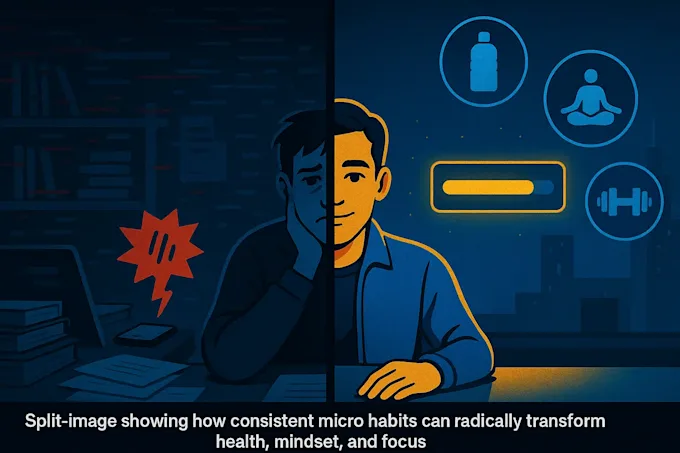
Micro habits are tiny, consistent actions that take less than two minutes to complete but compound into life-changing results over time. By working with your brain's natural reward system rather than against it, micro habits bypass the resistance that kills traditional habit attempts — making positive change feel effortless, automatic, and inevitable across every area of your life.
Check our article on ADHD Overthinking
In this comprehensive guide, you’ll discover:
Why traditional habit formation fails for 92% of people and how micro habits offer a neurologically-backed alternative
100 micro habits organized by category to help you grow in every area of life
What is the science behind micro habits? Learn how tiny actions reshape your brain through neuroplasticity
How to personalize these habits based on your goals, energy, and current routines
What Are Micro Habits & Why They Work
Micro habits are tiny, consistent actions that require minimal effort and time—typically less than two minutes to complete. But don't let their size fool you. These small actions work by rewiring your neural pathways through a process neuroscientists call "neuroplasticity."
Every time you perform a micro habit, your brain creates and strengthens neural connections associated with that behavior. The principle "neurons that fire together, wire together" explains why these tiny actions, when repeated consistently, become automatic over time.
Traditional habit formation often fails because it leans too heavily on motivation and willpower, both of which are finite resources that burn out fast. Research from University College London found it takes an average of 66 days to form a new habit, yet most people abandon their attempts within the first two weeks. Micro habits sidestep this entirely by asking so little of you that failure becomes nearly impossible.
Micro habits, by contrast, require almost no willpower because they're so small. They work by leveraging the habit loop identified by MIT researchers: cue, craving, response, and reward. Because micro habits are easy to complete, your brain quickly associates them with the reward of accomplishment, creating a positive feedback loop that encourages repetition.
The Compound Effect: Small Actions, Massive Results
The true power of micro habits lies in the compound effect.For a deeper look at how delayed rewards compound into real results, read How to Delay Gratification. Just as compound interest transforms small financial investments into significant wealth over time, consistent micro habits create exponential personal growth.
Consider this: improving just 1% each day makes you 37 times better over a year. That's not a typo, it's the mathematics of compounding in action. James Clear laid out this principle in Atomic Habits, arguing that small, consistent gains matter far more than occasional bursts of motivation. Charles Duhigg, author of The Power of Habit, adds another layer, showing that certain habits create ripple effects that automatically improve other behaviors around them, which is exactly what makes micro habits so disproportionately powerful.
This principle aligns with what I call the Equation of Life:
Your Belief System + Your Repeated Actions + Time = Who You Will Become.
Micro habits are the perfect "repeated actions" because they're sustainable and compound over time, gradually transforming who you are at your core.
Read More: Identity Based Habits
Why Micro Habits Succeed Where Traditional Habits Fail
Traditional habit formation approaches often fail for three key reasons:
They're too ambitious: Most people try to change too much at once, triggering overwhelming resistance.
They ignore identity: Lasting change happens when new habits align with your identity rather than just your goals.
They rely on motivation: Motivation fluctuates, making it an unreliable foundation for lasting change.
Micro habits solve these problems by:
Being almost comically small: So small, your brain doesn't resist them
Building a "growth owner" mindset: Each successful micro habit reinforces your identity as someone who follows through
Eliminating the need for willpower: When actions require minimal effort, motivation becomes irrelevant
Read our article on Social Habits
Now that you understand why micro habits work, let's explore 100 powerful examples across different categories of life.
100 Powerful Micro Habits for Success
Morning Micro Habits
Drink a glass of water immediately upon waking to rehydrate your body after 6-8 hours without fluids.
Make your bed as soon as you get up to start your day with an immediate accomplishment.
Place your feet on the floor for 5 seconds before standing up and set a positive intention for the day.
Name three specific things you're grateful for before getting out of bed.
Stretch for 60 seconds to activate your muscles and boost circulation.
Take three deep breaths before checking your phone or email.
Read just one page of a book with your morning coffee or tea.
Write down your top three priorities for the day in 30 seconds or less.
Place your workout clothes next to your bed the night before to trigger morning exercise.
Drink your coffee or tea without looking at screens to practice mindful consumption.
Step outside for 30 seconds to get natural light, which helps regulate your circadian rhythm.
Listen to an uplifting song while getting ready to set a positive tone.
Say a positive affirmation while looking in the mirror during your morning routine.
Do one pushup, squat, or jumping jack to jumpstart your metabolism.
Put your phone in another room while eating breakfast to practice presence.
Add a single vegetable or fruit to your breakfast for added nutrition.
Visualize yourself successfully completing your most important task for two minutes.
Set a timer for two minutes of meditation or mindful breathing.
Drink your coffee or tea black to reduce sugar intake.
Check tomorrow's weather and schedule for 30 seconds to mentally prepare.
Productivity Micro Habits
Close all browser tabs before starting your workday to reduce digital distraction.
Set a timer for 25 minutes of focused work (Pomodoro Technique).
Identify and complete the smallest possible next step of a challenging task.
Delete or archive five emails each time you check your inbox.
Write down one accomplished task on a "done list" to visualize progress.
Stand up and stretch for 60 seconds every hour to improve circulation and focus.
Place your phone face-down and out of reach during focused work periods.
Take one deep breath before opening your email inbox.
Start meetings by stating their purpose and end time to improve efficiency.
Use the "touch it once" rule for paperwork – handle it immediately rather than setting it aside.
Write tomorrow's to-do list before ending your workday.
Clear your workspace completely before leaving for the day.
Respond to one email during downtime instead of social media scrolling.
Take a 10-second pause before saying "yes" to a new commitment.
Set your most important task as your first activity when you start work.
Turn off all notifications for at least one hour of deep work daily.
Use waiting time (in lines, elevators, etc.) to review your goals.
Drink a full glass of water between tasks for hydration and a mental reset.
Park further away from your destination to add more steps to your day.
Take the stairs instead of the elevator for an easy fitness boost.
Looking for a broader system behind these habits? How to Be Productive in Life covers 13 science-backed strategies that pair well with everything in this section.
Health & Wellness Micro Habits
Eat one extra vegetable with dinner each night.
Place a glass of water on your nightstand before bed.
Floss just one tooth to build the flossing habit gradually.
Do five wall pushups while waiting for your coffee to brew.
Replace one processed snack with a piece of fruit or nuts.
Take a deep breath and stand up straight whenever you walk through a doorway.
Use a smaller plate for meals to control portion sizes.
Stretch for 30 seconds before getting into bed.
Place workout clothes and shoes by the door as a visual exercise reminder.
Set a hydration alarm on your phone as a reminder to drink water.
Add one healthy food item to your grocery cart each shopping trip.
Measure your portions for just one meal a day to increase awareness.
Take vitamin supplements with breakfast to establish consistency.
Apply sunscreen to your face every morning regardless of weather.
Turn off all electronic devices 30 minutes before bedtime for better sleep.
Place your phone in another room when sleeping.
Do one balance exercise (like standing on one foot) while brushing your teeth.
Take a 60-second stretch break for every hour of sitting.
Put on workout shoes as soon as you wake up or get home.
Chew each bite of food at least 15 times to aid digestion.
Mental Health & Mindset Micro Habits
Practice the "5-4-3-2-1" grounding technique when anxious (notice 5 things you see, 4 things you feel, 3 things you hear, 2 things you smell, 1 thing you taste).
Write down one win at the end of each day, no matter how small.
Compliment yourself when looking in the mirror.
Take one deep breath before responding to any message or email.
Replace "I have to" with "I get to" when talking about responsibilities.
Jot down one anxious thought and challenge it with evidence.
Spend 30 seconds visualizing a successful outcome before any challenging task.
Say "no" to one unnecessary commitment each week.
Set a daily worry time of just 5 minutes rather than worrying throughout the day.
Delete one social media app from your phone's home screen.
Write down one thing you're proud of each evening.
Mute notifications for all non-essential apps.
Respond to compliments with a simple "thank you" instead of deflecting.
Add a 10-minute buffer between appointments to reduce rushing stress.
Name one thing you're looking forward to each morning.
Take a screenshot of positive messages or feedback to review when needed.
Place a sticky note with an encouraging phrase where you'll see it regularly.
Turn your phone to grayscale mode to reduce its addictive appeal.
Set a social media timer for 10 minutes less than your usual usage.
Take a 30-second "awe pause" to appreciate something beautiful or remarkable.
Related Article: Fun Activities to Improve Mental Health
Relationship Micro Habits
Send a "thinking of you" text to someone you care about.
Use people's names when speaking to them.
Put your phone away completely during conversations.
Ask one meaningful follow-up question during conversations.
Share one genuine compliment with someone daily.
Express appreciation for one thing your partner or family member did.
Send a thank-you message to someone who helped you recently.
Make eye contact for a full minute during conversations.
Greet service workers by name when possible.
Ask "How can I help?" to one person each day.
Create a "connection reminder" on your calendar to reach out to distant friends.
Wait three seconds after someone finishes speaking before responding.
Replace "you always/never" with "I feel" during disagreements.
Share one positive observation about someone's strength or quality.
Respond to good news with active enthusiasm rather than passing acknowledgment.
Send one handwritten note each month to someone special.
Set your phone to "Do Not Disturb" during meals with others.
Research one topic that interests someone you care about.
Set a 60-second timer to fully listen without planning your response.
End each day by thanking someone in your household or sending a goodnight text.
Learn More: 52 Life Changing Habits Everyone Should Adopt
How to Make These Micro Habits Stick With Momentum-Boosting Methods
To take your micro habits to the next level and ensure they become permanent parts of your life, implement these three powerful momentum-boosting methods:
Make It Obvious/Attractive
The first momentum-boosting method focuses on making your micro habits impossible to miss and irresistibly appealing.
Key Strategies:
Create visual cues: Place physical reminders of your desired habits where you'll see them. For example, if you want to drink more water, place a water bottle by your bed, desk, and in your car.
Design your environment: Arrange your physical space to make good habits easier and bad habits harder. If you want to read more, place books on your nightstand and your TV remote in a drawer.
Use habit bundling: Pair something you need to do with something you want to do. For example, only listen to your favorite podcast while walking, or only watch Netflix while folding laundry.
Join a culture where your desired behavior is the norm: Surround yourself with people who already practice the habits you want to adopt. Their behavior will make your new habits seem more attractive and normal.
If you want to go deeper on mastering any of these habits at a high level, The 10,000 Hour Rule Explained reframes what real skill-building looks like over time.
Example Application:
If your chosen micro habit is "Read one page of a book daily," you could:
Place the book on your pillow during the day (visual cue)
Remove social media apps from your phone's home screen (environment design)
Only allow yourself to enjoy your favorite tea while reading (temptation bundling)
Join a book club or reading challenge (cultural reinforcement)
Make It Easy
The second momentum-boosting method focuses on reducing friction and making your micro habits as effortless as possible.
Key Strategies:
Reduce friction: Eliminate steps between you and your good habits. For example, if you want to exercise in the morning, sleep in your workout clothes.
Prime your environment: Prepare your surroundings in advance. Lay out everything you need for tomorrow's habit the night before.
Use the two-minute rule: Scale down any habit to something that takes two minutes or less to start. For example, "Exercise for 30 minutes" becomes "Put on my running shoes."
Automate when possible: Use technology or systems to make habits automatic. Set up automatic transfers to your savings account or use app blockers during focus time.
Example Application:
If your chosen micro habit is "Meditate for one minute daily," you could:
Keep a meditation cushion in the middle of your living room (reduce friction)
Set up a meditation app with a one-minute timer before bed (prime environment)
Start with just one deep breath (two-minute rule)
Set a daily calendar reminder that opens your meditation app (automation)
Make It Fun/Rewarding
The third momentum-boosting method focuses on creating immediate satisfaction and enjoyment from your micro habits.
Key Strategies:
Design immediate rewards: Create a small, immediate reward for completing your habit. For example, after flossing one tooth, give yourself a mint that you only get after flossing.
Create a habit tracker: Build a visual system that shows your progress and creates satisfaction when you mark off each completion.
Make it social: Share your progress with others or create friendly competitions around your habits.
Example Application:
If your chosen micro habit is "Do one pushup daily," you could:
Give yourself a mental high-five after each pushup (immediate reward)
Use a habit tracking app with satisfying visuals when you check off your daily pushup (habit tracker)
Join an online community where you share your daily exercise wins (social reinforcement)
Read More: How to Build Discipline and Consistency
Conclusion - Micro Habits:
I started with one tiny shift. Not a complete lifestyle overhaul, not a 30-day transformation challenge. Just a single focus, applied consistently, until it stopped feeling like effort and started feeling like me.
That's what micro habits did for my ADHD brain. They didn't require me to become a different person overnight. They just asked me to show up in the smallest possible way, day after day, until the compound effect did the heavy lifting for me. Grades that once felt out of reach became a natural byproduct of who I was becoming.
The same principle applies to you, regardless of where you're starting. Pick one habit from this list. Make it so small it feels almost embarrassing. Then make it obvious, make it easy, and make it rewarding enough that you actually want to come back tomorrow. Do that long enough, and you won't just have better habits. You'll have a better sense of who you are and what you're capable of. That's when the real momentum begins.
🚀 READY TO DISCOVER YOUR #1 MICRO HABIT THAT UNLOCKS ALL THE OTHERS?
You've just learned 100 micro habits—but here's what changes everything: the Moore Momentum System uses AI to pinpoint your exact "Golden Habit"—the one tiny action that creates the biggest ripple effect across all 5 Core Areas of life. Instead of guessing which micro habit to start with, you'll get a personalized Momentum Score that reveals exactly where you're stuck and which micro habit will give you maximum momentum right now.
👉 Take the Core Values Quiz in under 60 seconds to discover your personalized starting point. You'll get instant clarity on your current standing, see your biggest friction points, and unlock a gamified system that makes building micro habits feel more like leveling up than relying on willpower.
UNLOCK YOUR GOLDEN MICRO HABIT NOW!
🚀🚀🚀 Don't forget to check out our RESOURCE ARCADE 👾🎮 for FREE templates and tools to gamify your habits.

Frequently Asked Questions About Micro Habits
How long does it take for a micro habit to become automatic?
Research from University College London suggests the average habit takes around 66 days to become automatic, though this varies widely depending on the person and the behavior. The advantage of micro habits is that their low friction accelerates the process. Because you're not fighting resistance every day, the repetition needed to wire the habit into your brain happens faster and with far less willpower.
What is the difference between a micro habit and an atomic habit?
James Clear popularized the term "atomic habit" to describe small habits that are both tiny in size and fundamental to larger systems of behavior. Micro habits operate on the same principle. The key distinction is framing: atomic habits emphasize the system behind the behavior, while micro habits emphasize the size of the starting action. In practice, the two concepts reinforce each other. Starting small is the strategy; building a system around that small action is what makes it last.
How many micro habits should I start with?
One. Seriously. The biggest mistake people make is stacking five new habits at once and burning out within a week. Pick the single micro habit most connected to the area of your life where you feel the most friction right now. Build that one until it feels automatic, then layer the next one on top. Momentum compounds faster when you go narrow first. Not sure which area of your life to start with? 15 Questions to Discover Your Life Purpose can help you narrow it down fast.
Can micro habits work if I have ADHD?
Yes, and in many ways micro habits are better suited to an ADHD brain than traditional habit approaches. The two-minute rule removes the activation energy that ADHD makes so hard to generate. Pairing a micro habit with an existing cue, like drinking water right after your morning alarm, reduces the reliance on working memory and planning. The key is making the habit so small and so obvious that your brain barely registers it as a task at all.


Founder & CEO of Moore Momentum
Will Moore is a serial entrepreneur, life coach, and habit science expert with a $300M+ exit under his belt. After hitting suicidal rock-bottom as a teen, he dedicated his life to cracking the code on lasting happiness and success — and built Moore Momentum to share what he found.
He helps people discover WHO they are, WHAT they really want, and HOW to get there by combining proven principles, science, AI, and gamification.
His mission: make growth ethically addictive and inevitable.